Right to Dry
“RIGHT TO DRY” IN THE UNITED STATES
Legislative trends supporting natural laundry drying and their commercial significance for the ZIPZAP Segment System
Document: Right to Dry USA
Version: 1.0
Intended for: Investor Due Diligence / Intellectual Property Acquisition
Confidentiality Level: Confidential – for investors only
Executive Summary
An increasing number of states in the United States are adopting legislation or legal measures supporting the “Right to Dry” principle, which protects the right of property owners to dry laundry naturally using solar energy. These regulations limit the ability of homeowners’ associations (HOAs), property management companies, and similar organizations to completely ban the use of outdoor clotheslines.
This legislative development presents a significant commercial opportunity for the ZIPZAP Segment System technology. Consumers are increasingly seeking eco-friendly and energy-efficient household solutions, and “Right to Dry” legislation creates a favorable environment for modern systems designed for natural laundry drying.
ZIPZAP aligns naturally with this trend by offering a modern, portable, and user-friendly alternative to traditional clotheslines, while simultaneously promoting energy savings and a sustainable lifestyle.
1. What is the “Right to Dry” principle?
The “Right to Dry” principle represents a legally supported right for residents to dry their laundry naturally in the fresh air using sunlight and wind, rather than relying on electric dryers.
Its primary objectives are:
- Reducing electricity consumption
- Lowering carbon dioxide emissions
- Promoting the use of renewable energy sources
- Increasing household energy efficiency
- Reducing energy costs
- Encouraging a sustainable lifestyle
The principle is based on the idea that sunlight and wind are free, renewable energy sources that can significantly reduce household energy demand.
2. Reasons for adopting “Right to Dry” legislation
This legislation emerged in response to several long-term trends:
- Rising electricity prices
- Climate change
- State and federal sustainability support programs
- Demands for energy savings
- Growing consumer interest in eco-friendly products
Electric dryers are among the most energy-intensive household appliances. Natural air-drying offers a simple way to reduce electricity consumption while also extending the lifespan of textiles.
3. Legislative developments in the United States
Since the beginning of the 21st century, a growing number of U.S. states have enacted laws limiting the authority of homeowners’ associations to ban the use of outdoor clotheslines.
Although specific legal regulations vary from state to state, the overall legislative trend points toward greater freedom for consumers to use natural drying methods.
This development is proceeding alongside an increasing emphasis on renewable energy sources and energy-efficient housing.
4. States Supporting the “Right to Dry”
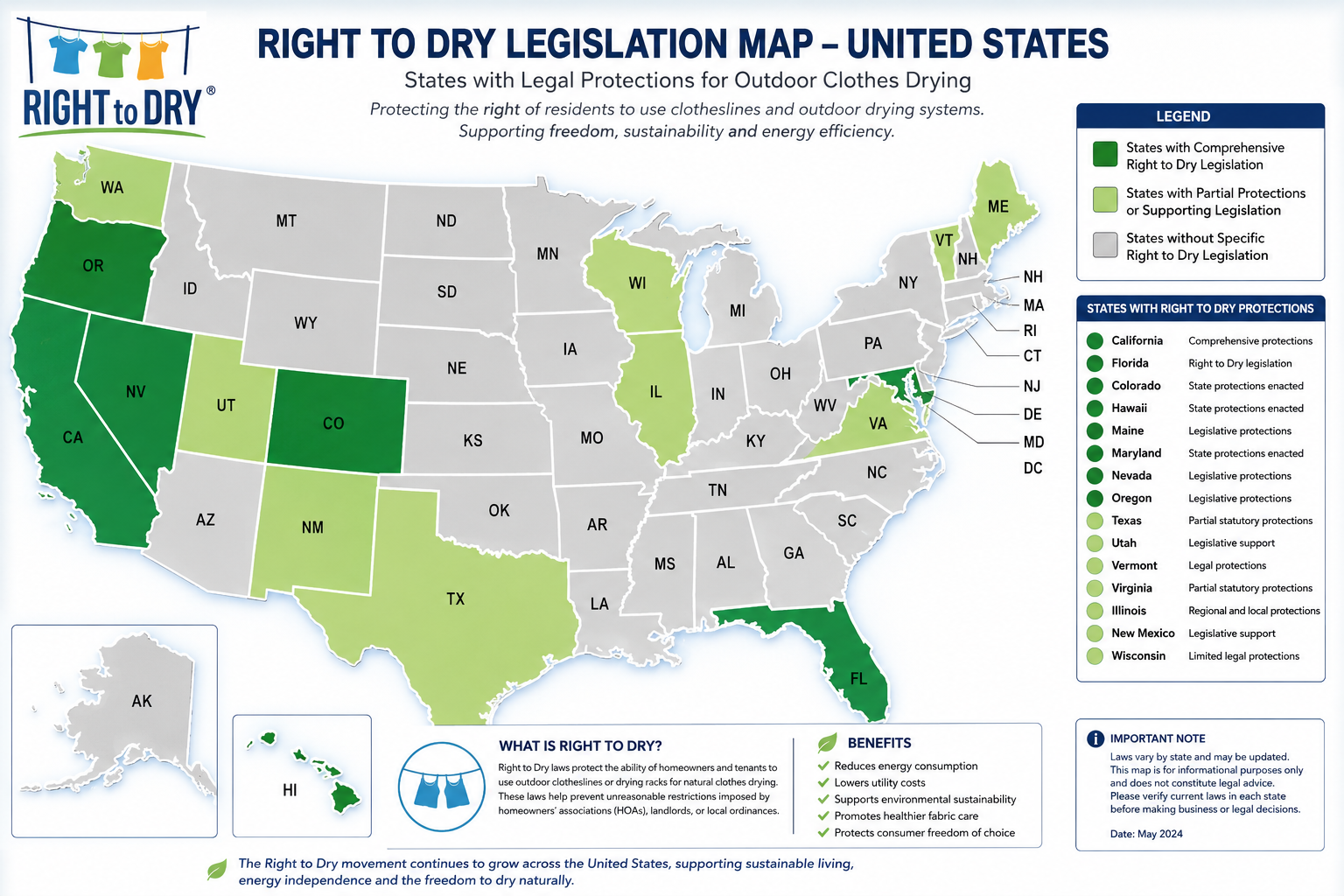
States that have adopted or support legislative measures regarding the “Right to Dry” include, for example:
- Florida
- California
- Colorado
- Hawaii
- Maine
- Maryland
- Virginia
- Utah
- Oregon
- Illinois
- Nevada
- Texas
- New Mexico
- Wisconsin
- Indiana
- Kansas
- Arizona
- Idaho
- Louisiana
- Vermont
These states represent attractive target markets for modern natural laundry drying technologies, such as the ZIPZAP Segment System.
5. Energy Benefits
Natural laundry drying enables households to:
- Reduce electricity consumption
- Lower annual energy costs
- Extend the lifespan of textiles
- Limit the use of electric dryers
- Increase household energy efficiency
Regular use of natural drying can significantly reduce annual costs associated with operating electric dryers.
6. Environmental Benefits
ZIPZAP® technology supports:
- Reducing greenhouse gas emissions
- Lowering household carbon footprints
- Utilizing renewable solar energy
- Environmentally responsible consumer behavior
- Long-term sustainable development goals
The product fits naturally among modern eco-friendly household solutions.
7. Alignment of ZIPZAP technology with the “Right to Dry” principle
ZIPZAP significantly improves upon the traditional method of drying laundry by offering:
- Peg-free laundry attachment
- One-handed operation
- Increased drying capacity
- Modular length extension
- Quick assembly
- Easy portability
- Indoor and outdoor use
- Suitability for balconies
- Suitability for gardens
- Use while camping and in recreational vehicles
- Convenience for travel
Greater ease of use encourages wider adoption of natural laundry drying.
8. Commercial potential in the U.S. market
“Right to Dry” legislation supports demand growth in the following areas:
- Eco-friendly household products
- Outdoor drying systems
- Portable clotheslines
- Camping equipment
- RV accessories
- Solutions for balconies and urban living
- Sustainable consumer products
- Home improvement retail
- Online sales
- Licensing opportunities
ZIPZAP is suitable for all the listed market segments.
9. Competitive advantages of ZIPZAP technology
Compared to traditional clotheslines, ZIPZAP offers:
- Fastening without clothespins
- Quick insertion of laundry into patented segments
- Easy removal of laundry
- One-handed operation
- Higher drying capacity for the same line length
- Low weight and easy portability
- Modular design
- Easy installation
- Minimal maintenance
- Long service life
These features represent a significant competitive advantage in the U.S. market.
10. Market potential
Long-term trends supporting commercialization include:
- Growing interest in eco-friendly products
- Rising electricity prices
- Growth of caravanning and camping
- Expansion of Tiny House communities
- Off-grid living
- Environmentally conscious consumers
- Growth of urban balcony living
- Growth of the energy-efficient household market
These trends create favorable conditions for introducing ZIPZAP technology to the U.S. market.
11. Impact on Intellectual Property Value
“Right to Dry” legislation significantly enhances the commercial value of ZIPZAP’s intellectual property portfolio.
An investor or acquirer gains not only patent-protected technology but also entry into a market supported by:
- Favorable legislative developments
- Growing environmental awareness
- Rising energy prices
- Long-term sustainability goals
- Increasing demand for energy-efficient solutions
These factors reduce commercial risk while simultaneously boosting the potential for future licensing revenue.
12. Conclusion
The “Right to Dry” principle represents a significant long-term legislative and societal trend that supports natural laundry drying as an energy-efficient, eco-friendly alternative to electric dryers.
Thanks to its patented segment technology, modular design, peg-free laundry attachment, and field-proven functionality, the ZIPZAP® Segment System is exceptionally well-positioned to capitalize on this trend.
Combined with patent protection, proven technology, and strong consumer appeal, ZIPZAP® represents a highly promising candidate for licensing or acquisition in the U.S. market.
Recommended VDR Attachments
- Right to Dry State Legislation – Overview of “Right to Dry” legislation across individual U.S. states.
- USA Right to Dry Map – Map of the United States highlighting states that support the “Right to Dry” principle.
- Commercial Impact of Right to Dry – Analysis of the legislation’s impact on the commercial potential of ZIPZAP® technology.
- Energy Savings Analysis – Analysis of electricity savings achieved through natural laundry drying.
- U.S. Market Size for Outdoor Drying Solutions – Analysis of market size, growth trends, and commercialization opportunities in the U.S.


